There are four steps to working out how much Universal Credit you will be paid.
Your Universal Credit is is assessed every month, at the end of your Assessment Period.
As your income and circumstances change, so will the amount of your Universal Credit award.
The four steps are:
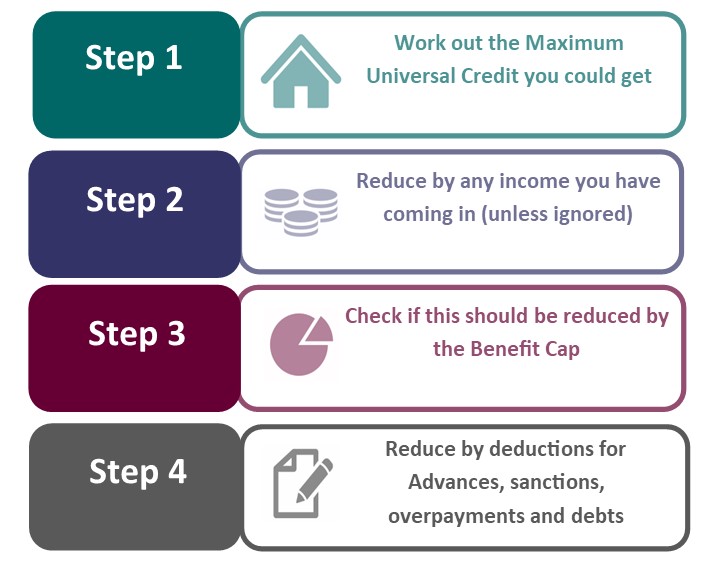
TIP: You can see how your Universal Credit has been worked out by going to the payments section of your UC account.
Maximum Universal Credit
The first step to working out how much Universal Credit you are entitled to is to work out the maximum you could get.
It is your personal circumstances on the date of the assessment that the DWP will use – this is the last day of your Assessment Period.
The maximum Universal Credit amount for your household is calculated by adding together various Allowances and Elements. This will be made up of one Standard Allowance and any additional Elements that apply to you and your household (for example, for housing costs or children).
It is worth checking that the DWP have included all the Elements that you are entitled to, as mistakes are made.
We have listed below the Allowance and various Elements that are available.
Standard Allowance
Your monthly amount will depend on whether you are single or in a couple, and your age:
| Your circumstances | Monthly Standard Allowance |
| Single and under 25 | £338.58 |
| Single and 25 or over | £424.90 |
| In a couple and you’re both under 25 | £528.34 |
| In a couple and either of you are 25 or over | £666.97 |
Housing Costs Element
If you and/or your partner pay rent and/or service charges. See If you pay rent for more information.
Child Element
If you are responsible for a child or young person who lives with you. See If you have children for more information.
Disabled Child Element
If you are responsible for a child who is getting Disability Living Allowance / Child Disability Payment or Personal Independence Payment / Adult Disability Payment. See If you have children for more information.
Childcare Costs Element
If you (or your partner) pay childcare costs to enable you (or them) to work. See If you have children for more information.
Limited Capability for Work Related Activity Element
If you (or your partner) have been found to have a Limited Capability for Work Related Activity, are getting New-Style ESA and are in the Support Group, or were previously getting Income-Related ESA in the Support Group when you made your claim for Universal Credit.
See If you have a health issues for more information.
Carer Element
If you (or your partner) are caring for a severely disabled person 35 hours or more a week (it doesn’t matter if you/your partner are in work, or how much you/your partner earn – you may still be entitled. See If you are a carer for more information.
Transitional SDP Element
Can be included if you were getting a Severe Disability Premium in an award of Income-Related ESA, Income Support or Income-Based JSA before claiming UC. Strict rules apply.
Migration Transitional Element
Can be included if you were getting Income-Related ESA, Income Support, Income-Based JSA, Housing Benefit and/or Tax Credits before you claimed Universal Credit and you claimed because you received a managed migration notice.
IMPORTANT: If you feel that an Element that you are entitled to is missing from your Universal Credit assessment contact a Benefits Adviser for help.
Example:
Dan is single, age 24 and lives in a one bedroom social housing flat with a rent of £110 per week.
He works in a call centre and his hours have just been cut – his net monthly wage will drop to £1,071.
If Dan makes a claim for Universal Credit, he will be entitled to over £200.00 per month (before any deductions if applicable).
Example:
Jaz is 30 and lives with her 9 year old daughter in a two bedroom rented property (rent £145 a week). She’s been working full time but has lost her job and so has made a claim for Universal Credit. Jaz will be entitled to over £1400.00 per month (before any deductions if applicable).
TIP: Many workers are entitled to Universal Credit but don’t realise it. If you’re not sure whether you’ll be entitled or not, then speak to a Benefits Adviser – it is always worth checking to see if you could be entitled to Universal Credit.